Showing posts with label Facts. Show all posts

Friday, 21 June 2019

Booking Grab ride in Malaysia? Submit selfie first

Booking Grab ride in Malaysia? Submit selfie first


All Grab users in Malaysia will soon have to do a one-time selfie verification in order to use the app in the country. This is to fulfil regulatory requirements.

It will be similar to what new Grab users in Singapore are already doing, and a company spokesman said yesterday that Singaporeans would also have to comply with the Malaysian rule when using the app across the Causeway.

Grab, through an announcement on its Malaysian app and its website, informed users recently that the compulsory measure will be in place by July 12.

The website message read: "The selfie is for identity verification, safety, and may be used to assist the authorities when required. Grab ensures that your selfie and identity are secure and will not be shared with our driver-partners and merchants."

Grab added that explicit permission would be sought before any access to users' cameras.

Malaysian Transport Minister Anthony Loke had last July announced that, as part of new rules, passengers would have to upload valid identification card or passport details when they register for a ride-hailing account. He gave a year's grace to meet the requirements.

Grab adopted facial recognition technology to meet the new rule, with first-time users required to submit a selfie of themselves before booking a ride.

The Star daily reported that the new requirement has already helped solve a robbery-cum-murder case involving a Grab driver. Two suspects were nabbed in connection with the death of Mr Mohd Hanafiee Jaafar, who was robbed and killed on the job last month.

The incident resulted in drivers fearing post-midnight trips and avoiding areas deemed dangerous, The Star said.

Within Singapore, Grab users who signed up before February this year did not have to go through selfie verification, with their identities verified by either their Facebook account or credit card details.

But new users signing up from February have had to submit selfies to successfully open their accounts.

The Grab spokesman said: "These are part of our ongoing efforts to ensure high safety and security standards on our platform for both our customers and driver-partners."

Singaporeans who use Grab during trips to Malaysia told ST that they did not mind submitting a selfie so long as it was used solely for verification purposes.

Ms Wong Shi Hui, 25, who works in events management and visits Malaysia every three months, said: "It is good that measures are in place to protect drivers as well. Selfies seem harmless enough if they can ensure a safe ride for everyone."

~The Straits Times~

Thursday, 2 May 2019

Yummy season is coming soon

Yummy season is coming soon

Red Prawn and Black Thorn were among the species favoured by durian lovers, said Bao Sheng Durian Orchard owner Chang Teik Seng.

“The trees of these two species are much older, grown in the 1960s,” he explained.

The Balik Pulau durian is generally believed to be tastier due to the favourable weather conditions as the trees are planted on the hills and facing the sea.

The MyIPO is an agency under the purview of the Domestic Trade and Consumer Affairs Ministry.

Durian Rumah Batu Balik Pulau owner Tan Hock Hoe said the durian season should start from the last week of this month.

“The durians are not yet ripe as the flowers only began to bloom around March this year,” he said, adding that those sold now were mostly from outside Penang.

In George Town, trader Teoh Nai Teik said they were selling durian from Kuala Kangsar and some from Thailand, while waiting for the Balik Pulau durian season to start.

“Customers will always want to know where the durians are from. Some prefer to wait for Balik Pulau durian,” he said.

At the Penang state assembly yesterday, all the Yang Berhormat savoured a durian feast which featured Musang King, Black Thorn, D101, D24, D12 and D15, among others.

“This puasa month will see durian feasts happening,” said state Agriculture and Agro-based Industries Committee chairman Dr Afif Bahardin.

“We expect an abundant supply this season.”

On the export of Penang durian, Dr Afif said since the fruits were best eaten fresh, travel agencies had been marketing durian eating tours overseas.

Thus, the thorny attraction is expected to lure crowds of durian-loving tourists to Penang soon.

The feast for state legislators, government officers and the press were prepared by the state Agriculture Department.

Assistant agriculture officer Abdul Halim Abdul Aziz said the fruits were gathered from mainland orchards in Machang Bubok and near the southern border of Kedah.

“The Balik Pulau durian is not ripe yet. Give them another week or two,” he said.

It has been eight months since the Penang durian hit the streets, unlike last year which saw the longest durian season in recent memory in northern Malaysia.

Durian stalls mushroomed in late February last year. The fruits were sold till May, followed by another round in late June.

The market was so satiated last year that by late July, the price of Musang King plummeted to just RM28 per kilo from about RM60 per kilo.

In Machap, Melaka, Alan Yap, who helps his father manage their four-hectare orchard named Sim Koa Yen, said durian fans would get to enjoy the fruit beginning July.

“The fruit will be ready for harvest sometime in mid or late June. But the first week of harvest is usually not stable in terms of taste and quality. So we normally don’t sell them.

“Starting July, most of the species will give a consistent and tasty flesh throughout the season, which is expected to last for two to three months,” he said.

Yap, whose family orchard has 30 durian species, said the Jiabili and Green 15 types were considered premium fruits after the famed Musang King.

The start of the durian season would see species such as D7, D14 and D3, he said.

“In the mid-season, popular ones such as Musang King and D24, as well as other premium species like Jiabili and Green 15, will be more easily available.

“And before the season reaches the end, we will see more of Ang Bak and Hong Ren in the market,” he added.

With a stable supply expected, he said durian prices would likely maintain this season.

“Last year, Musang King was sold for RM60 per kg while Jiabili and Green 15 were RM45 per kg.

“The harvest will be good as long as there’s no excessive rain,” he said.

~News courtesy of The Star~

Monday, 31 December 2018

Wednesday, 19 December 2018

Cheong Fatt Tze Mansion

The Cheong Fatt Tze Mansion is a government gazetted heritage building located on Leith Street in George Town, Penang, Malaysia. The mansion's external decorations and indigo-blue outer walls make it a very distinctive building, and it is sometimes referred to as The Blue Mansion.

Built by the merchant Cheong Fatt Tze at the end of the 19th century, the mansion has 38 rooms, 5 granite-paved courtyards, 7 staircases and 220 vernacular timber louvre windows. It served as Cheong's private residence as well as the seat of his business activities in Penang.


The mansion is eclectic, but mainly reflects Chinese architectural styles of the Imperial Period. Features of the house include Gothic louvred windows, Chinese cut and paste porcelain work, Stoke-on-Trent floor tiles made of encaustic clay in geometric pieces all shaped to fit to a perfect square, Glasgow cast iron works by MacFarlane's & Co. and Art Nouveau stained glass windows.

The mansion was originally built with careful attention to the principles of Feng Shui. The domestic annexe is built in front of it to prevent any road being built to create a T-junction in front of it; it has water running through a meandering network of pipes that begin from the eaves of the roof, channelled through the upper ceiling, down the walls collecting in the central courtyard before being channelled away from the property via a similar network of pipes, in this case, underneath the entire flooring system and is built with a step in the middle to create a slope (to ride on the dragons back.)

The distinctive blue colour of the mansion is the result of mixing lime with natural blue dye made from the Indigo plant. The blue was very popular in the Colonial period and the dye was imported from India to Penang by the British. 

The lime-wash was very effective in a tropical weather as it absorbed moisture and cooled the house whilst dispelling moisture without damage to the structural integrity of the walls. Though white was the most easily available colour, the indigo-blue was chosen because it was highly-prized by all communities, adding stature to the mansion.

~wikipedia~

Friday, 14 December 2018

5 Rice Dishes to Try in Penang Apart From Nasi Kandar

5 Rice Dishes to Try in Penang Apart From Nasi Kandar

Hot on the heels of nasi kandar arrive these equally tasty rice dishes.

Rice is an important part of Penang’s rich culinary culture. We have it for breakfast, we crave it for lunch and we are quite hungry for it come dinner time. Penang has many variations of rice dishes. The late Anthony Bourdain may have fallen in love with nasi kandar but did you know that there are other equally delicious rice dishes apart from nasi kandar? Drop everything and dig into these underrepresented rice dishes in Penang.

Nasi Dalca


Ask long-time Penangites and they will tell you that nasi dalca is the most celebrated rice dish after nasi kandar. Also known as nasi ganja to the locals, the rice is cooked with lentils, onions, potatoes and carrots and spiced with star anise, cinnamon, and cardamom. It’s savoury, it’s creamy, it’s delicious! This uniquely northern rice dish is usually eaten with various side dishes such as fried chicken, mutton kurma, vegetables and a good dose of kuah dalca. It’s a local favourite you would not want to miss.

Where to try: Restoran Kassim Mustafa
Address: 12, Chulia Street, 10200, George Town
Operating hours: 24 hours

Worth the trip: Nasi Dalca Bawang
Address: Pasar dan Kompleks MBPP, Jalan Rajawali, Bayan Lepas
Operating hours: 6:30pm - 10:00pm (closed on Saturdays)

Nasi Tomato


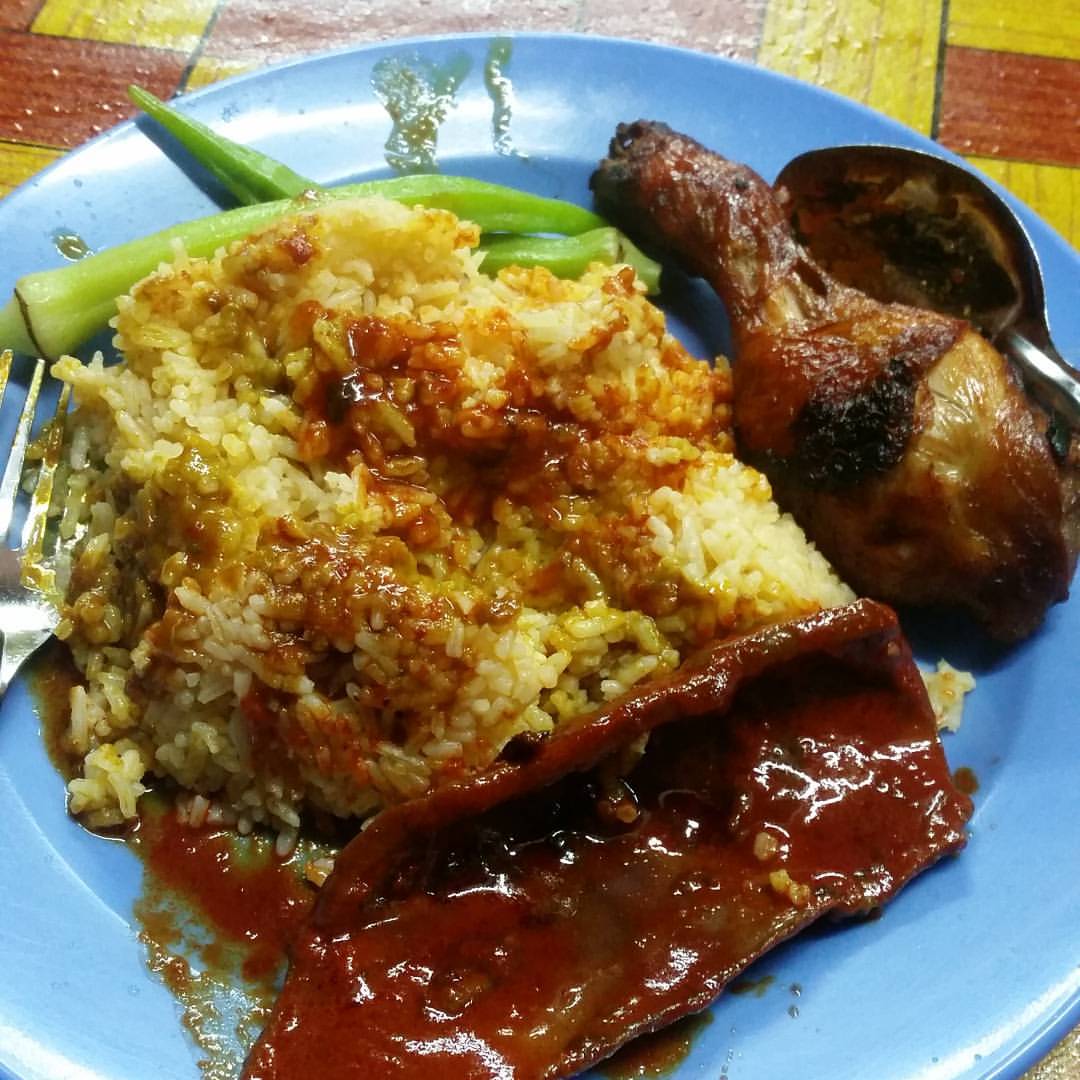
Cooked in tomato paste, ghee, milk, spices, garlic, onions and ginger, nasi tomato boasts a distinctive aroma and creamy aftertaste. It is often served with an assortment of side dishes such as ayam masak merah, gulai sotong, daging masak hitam and more. An addition that’s highly recommended is the jelatah – thinly sliced cucumbers, pineapples and onions mixed in vinegar for an extra zing!

Worth the trip: Nasi Tomato Batu Lanchang
Address: Flat Taman Seri Damai, Lintang Batu Lanchang
Operating hours: 10:30pm - 2:00am

Nasi Ulam Nyonya


While it is the daintiest rice dish on the list, there’s nothing simple about nasi ulam nyonya, a Peranakan aromatic herbed rice dish. According to Pearly Kee, the author of A Nyonya Inheritance and Pearly’s Nyonya Pantry, preparing nasi ulam nyonya takes time and patience. Fresh ingredients such as lemongrass, torch ginger (bunga kantan), kaffir lime leaves, daun kadok and others are sliced thinly and then tossed with cooked rice. Nasi ulam nyonya used to be a specialty to the Nyonya community during celebratory events such as birthdays or weddings but today, it is on the menu in many Nyonya restaurants in town.

Where to try: Moh Teng Pheow
Address: Lebuh Chulia (Jalan Masjid), 10200, George Town
Operating hours: 10:30am - 5:00pm (closed on Mondays)

Nasi Melayu


Set down your fork and spoon – nasi melayu is best eaten with hands. There is no specific rule to what makes nasi Melayu what it is – essentially it is white rice with an extensive spread of Malay dishes. Those who prefer a little heat may add gulai ayam, curry fish head and beef rendang to the mix. Ulam or fresh vegetables served raw or blanched are the trademark of nasi melayu; there’s usually a vast selection of freshly picked local herbs such as ulam raja, daun cekur, daun selom, pucuk gajus, petai, pegaga and daun kaduk to be eaten with a dollop of freshly made sambal belacan. Grilled fish is often paired with air asam, a condiment made of bird’s eye chilli, onions, diced tomatoes, kerisik, belacan and tamarind juice.

Where to try: Nasi Melayu Lidiana
Address: Medan Selera Tanjung Bunga
Operating hours: 7:00am - 9:00pm (closed on Sundays)

Worth the trip: Minah Restaurant
Address: Jalan Sultan Azlan Shah, Taman Tun Sardon, Gelugor
Operating hours: 10:00am - 5:00pm (closed on Mondays)

Nasi Lemuni


Ask any out-of-towner if they have heard of nasi lemuni and chances are the answer is "no". This uniquely northern rice dish is not only delicious, it is also very healthy. According to Chef Nurilkarim Razha from Jawi House Cafe Gallery, nasi lemuni is traditionally eaten as a confinement dish for new mothers in the northern Malay community. It is believed that daun lemuni enhances blood flow, balances hormones and improves one’s digestion. This rice dish is cooked with daun lemuni (Vitex trifolia) and is often accompanied by sambal, fried anchovies, toasted peanuts, hard-boiled eggs and cucumber. Today, one can find nasi lemuni in many Ramadhan bazaars during the fasting month.

Where to try: Jawi House Cafe Gallery
Address: 85, Armenian Street
Operating hours: 11:00am to 10:00pm (closed on Tuesdays)

Worth the trip: Nasi Lemuni
Address: Kompleks Majlis Bandaraya Pulau Pinang Lebuh Nipah (opposite Kayu Nasi Kandar)
Operating hours: 8:00am to 1:00pm (closed on Mondays and Tuesdays)

~Courtesy of myPenang~

Tuesday, 13 November 2018

Departure levy different from airport tax

Departure levy different from airport tax

The departure levy proposed in Budget 2019 is completely separate from the existing passenger service charge (PSC), said Transport Minister Anthony Loke.

Loke was responding to a question on the need to impose the levy which was set at RM20 to Asean countries and RM40 for non-Asean countries.

The PSC is not something collected by the government, that’s collected by Malaysia Airports Holdings Bhd (MAHB) to run the operations of the airport, he said.

“The departure levy introduced by the government, is a form of tax for anyone travelling out of the country. That is completely by the government, not by the airlines, not by the airports,” he said during the launch of AirAsia Bhd’s first fully-digitalised ground handling services control centre at klia2.

The departure levy is needed to raise revenue and the government could collect a few hundred million ringgit annually, he said.

Loke pointed out other countries such as Thailand and Indonesia had similar taxes for outbound travellers.

The mechanism, he said, would be announced later as implementation only starts on June 1.

He added the ministry has not decided on the mechanism to offer the 30% stake in the proposed Airport REIT (real estate investment trust), which forms part of the Budget 2019 proposal.

Fernandes hopes the proposed REIT would not increase costs.

“Obviously we would like to see full privatisation, so new airport operators can come in, we may see different ways of running airports, and not just giving 30% to Malaysian Airports as a different form of funding,” Fernandes said.

What the low-cost carrier needed, he added, was an airport operator and airport which understood AirAsia’s model in reducing costs, which he said would in turn reduce the costs of flying for passengers, allowing the carrier to build Malaysia into a strong aviation hub.

Meanwhile the ground handling services control centre will allow AirAsia’s Ground Team Red (GTR) to track aircraft handling, with real-time information on passenger boarding, baggage reconciliation and ramp-loading compiled on a digital dashboard at the control centre.

Loke was given an overall briefing of the way the centre functioned to compile the different data and identify any soft spots in the aircraft’s turnaround process.

~News courtesy of The Star~

Monday, 12 November 2018

Laksa

Laksa is a spicy noodle soup popular in Peranakan cuisine. Laksa consists of rice noodles or rice vermicelli with chicken, prawn or fish, served in spicy soup based on either rich and spicy curry coconut milk or on sour asam (tamarind or gelugur). Laksa is found in Malaysia, Singapore, Indonesia, and Southern Thailand.

The type of laksa is based upon the soup base employed in its recipe; either rich and savoury coconut milk, fresh and sour asam (tamarind, gelugur or kokum), or the combination of the two. 

There are three basic types of laksa: curry laksa, asam laksa, and other variant that can be identified as either curry or asam laksa. 

Curry laksa is a coconut milk curry soup with noodles, while asam laksa is a sour, most often tamarind-based, soup with noodles. Thick rice noodles also known as laksa noodles are most commonly used, although thin rice vermicelli (bee hoon or mee hoon) are also common, and some recipes might create their own rice noodle from scratch. Some variants might use other types of noodles; Johor laksa for example uses spaghetti, while a fusion recipe might use Japanese udon noodle.


Laksa lemak, also known as nyonya laksa (Malay: Laksa nyonya), is a type of laksa with a rich coconut gravy. Lemak is a culinary description in the Malay language which specifically refers to the presence of coconut milk which adds a distinctive richness to a dish. As the name implies, it is made with a rich, slightly sweet and strongly spiced coconut gravy. Laksa lemak is usually made with a fish-based gravy (with vegetarian food stalls omitting fish) and quite similar to Thai laksa (Malay: Laksa Thai), perhaps to the point that one could say they are one and the same.


Asam laksa is a sour, fish and tamarind-based soup. Penang Asam Laksa listed at number 26th on World's 50 most delicious foods compiled by CNN Go in 2011. Asam is the Malay word for any ingredients that makes a dish tastes sour (e.g. tamarind, gelugur or kokum). Laksa typically uses asam keping, known as kokum in the English speaking world, which is a type of dried slices of sour mangosteens. 

The modern Malay spelling is asam, though the spelling assam is still frequently used.
The main ingredients for asam laksa include shredded fish, normally kembung (small mackerel of the Rastrelliger genus), and finely sliced vegetables including cucumber, onions, red chillies, pineapple, lettuce, common mint, daun kesum (Vietnamese mint or laksa mint), and pink bunga kantan (torch ginger). Asam laksa is normally served with either thick rice noodles or thin rice noodles (vermicelli). And topped off with petis udang or "hae ko" (蝦膏), a thick sweet prawn/shrimp paste.


Source: Wikipedia and Facebook

Saturday, 3 November 2018

Departure levy at airports

Travel, departure levy at airports

AVID traveller Shahida Sakeri will think twice about going overseas for her holiday next year when the departure levy on travellers leaving Malaysian airports is introduced on June 1.

The government has proposed a fee of RM20 per head for those departing for Asean countries and RM40 for other countries.

Shahida said since she was used to travelling solo, it might not affect her as badly as those travelling in a large group. 

“For my aunts and uncles with many children, they will now have to bear the additional costs,” she said.

“I want to see more facilities for the disabled at our tourist attractions, such as increasing accessibility at museums and parks,” she added.

Malaysian Association of Tour and Travel Agents president Datuk Tan Kok Liang, on the other hand, described the move as “disappointing”.

“It will not have any significant impact on domestic tourism as leisure travellers are on extreme budget constraints and very price sensitive.

“Domestic tourism can be improved by providing healthier tourism fundamentals, better tourism packages and capping on domestic airfares,” he said.

However, Tan welcomed the RM100mil grant for private companies to boost international tourist arrivals through marketing efforts, which he called a “good surprise”.

Malaysian Inbound Tourism Association president Uzaidi Udanis said the money collected from the departure levy could be used to promote inbound travel.

However, he also warned that the move might deter airlines from increasing connectivity from the country.

“If there is lower demand for outbound travel, airlines might not be interested in introducing new routes from the country,” said Uzaidi.

Malaysia Airlines in a statement said that any funds generated and channelled back to the development of the aviation industry in general would only be positive for the sector.

Budget 2019 also allocated RM20mil to the Malaysia Healthcare Tourism Council (MHTC) to promote the country’s medical tourism industry.

MHTC chief executive officer Sherene Azli said this would further propel Malaysia’s profile as a leading global destination for healthcare tourism.

“This will go a long way in bringing Malaysia’s healthcare tourism to new heights while making a significant positive economic impact on the nation,” she said.

~Courtesy of The Star~

Thursday, 1 November 2018

Monday, 29 October 2018

Roti john

Roti john is an omelette sandwich founded by a Malay who lived in Singapore during the British colonial times before being widely popular throughout the Malay Peninsula in present-day Malaysia.


Roti is the Hindi, Urdu and Malay word for bread, and more generally for any bread-based or bread-like food, including sandwiches and pancakes. The origin of john in the name is allegedly due to the Western origin of the baguette and British colonial rule in British Malaya and Singapore island.

The ingredients include minced meat (chicken or mutton), onion, egg, tomato-chilli sauce and a baguette-type loaf.

~Wikipedia~

Tuesday, 18 September 2018

Express Buses to Penang (KKKL)


1. KL
2. Malacca
3. Batu Pahat
4. Johor Bahru

Monday, 17 September 2018

Monday, 3 September 2018

Enjoy your satay, there’s no tax for it at food outlets

Enjoy your satay, there’s no tax for it at food outlets

IPOH: There will be no Sales and Service Tax on satay sold in food outlets, says Finance Minister Lim Guan Eng.

He said the SST on the popular Malaysian food was imposed during the processing stage for the purpose of packaging and sales.

“It is the sales that get the SST, not at the outlets,” he told reporters after a briefing on the SST at a hotel here yesterday.

Lim was replying to a question on whether the SST would be imposed on chicken or beef satay sold in food outlets, as it was among the items listed as taxable under “preparation of meat”.


He said failure to do so would mean that they could not charge the SST and would have to use their own funds to pay the tax to the government.

His call was echoed by Customs Department director-general Datuk Seri T. Subromaniam, who said friendly visits by the department found that there were still food providers who had not updated their systems.

“We advised them to update their systems so that the 6% service tax could be charged,” he said.

In Shah Alam, Domestic Trade and Consumer Affairs Ministry secretary-general Datuk Seri Jamil Salleh said the real impact of the SST on the prices of general goods was expected to be fully felt in the second week of its implementation.

This is because goods sold during the first week after the end of the tax holiday are actually tax-free.

Noting that traders had bought the goods during the tax holiday period, he said the tax-free stocks should be sold at prices minus the SST.

“However, some traders might want to take advantage of the situation but we are ready for that.

“We have mobilised 1,000 enforcement personnel to check against profiteering.

“Legal action will be taken against profiteers, and I want them to be severely punished to deter others from doing the same,” he said after visiting a juice-producing factory yesterday.

The Price Control and Anti-Profiteering Act provides a fine of up to RM100,000 or a three-year imprisonment upon conviction.

~News courtesy of The Star~

Thursday, 30 August 2018

Malaysia welcomes tourists from all over the world

Malaysia welcomes tourists from all over the world

Malaysia continues to welcome tourists from all over the world, including China, without any restriction.

A statement from the Prime Minister’s office today said other than the usual immigration requirements for all foreign tourists, there are no other restrictions for anyone including visitors from China.

“Tourists from China will still be given a single-entry visa for up to 30-days stay in the country and are eligible to take up other programmes organised by the government as well,” it said.

The statement said property purchases by foreigners were also allowed irrespective of nationality but there were certain conditions imposed by the government.

“Purchase of property, however, does not guarantee automatic residency in the country. But for foreigners who wish to make Malaysia their permanent residence, they could consider the ‘ Malaysia, My Second Home (MM2H)’ programme.

”Malaysian government also welcomes foreign direct investment that contributes to the transfer of technology, provides employment for locals and the setting up of industries locally,” the statement read.

It added that last year Malaysia received 2.3 million Chinese tourists from China and it now aims to multiply the number to 10 million visitors in time to come.

Information on these programmes and conditions are available.

~News courtesy of New Straits Times~

Monday, 13 November 2017

Electric Train Service provides smooth ride from Kuala Lumpur to Perlis

Electric Train Service provides smooth ride from Kuala Lumpur to Perlis


Commuter Vincent Khor feels the interior of the electric train operated by Malayan Railways is comfortable and cosy. There are even power sockets under the seats.

I was very excited about taking Malaysia’s Electric Train Service (ETS) from Kuala Lumpur (KL) to Arau, Perlis, for the very first time.

It was probably the best decision I made on this trip – to travel by electric train instead of car or plane during the Labour Day weekend in April/May, to participate in the Perlis Marathon.

I bought my Malayan Railways ETS train ticket online.

When I fly, I prefer an aisle seat in the centre of the plane. I decided to make the same seat selection for the train ride. From the online ticketing system, I couldn’t tell if the seat I had chosen was facing the direction the train would be moving or the other way around. And I also couldn’t tell if the cafeteria was in the same coach.

What I was looking forward to was a nice, cosy seat with peace, quiet and privacy so that I could get some sleep. I needed some rest ahead of the marathon, which was held exactly one minute past midnight on the day I arrived.

While waiting for the train, scheduled to depart KL Sentral Station at 7.05am, I bumped into so many runners, some of whom I knew. They were also planning to take the same train and take part in the same marathon.

As I was about to board, I saw Kin K Yum (the marathoner, photographer and newspaper columnist) pushing his foldable bike and walking towards the train platform. I chatted with him for a while. He told me he was waiting for another friend Chan Wai Yee, who I met later, who also brought along a foldable bike. That was such an awesome idea – travelling with foldable bike for leisure cycling after the run in Perlis!

We found out that we were in different coaches so off we went to our separate seats.

TRAIN TO PERLIS

As I entered Coach C, I passed through a nice-looking cafeteria.

My seat was in a four-seat layout, with two seats facing another two, and a blue table in the middle. Throughout the journey, I was not be able to stretch my legs comfortably. Or if I took a nap, strangers sitting across me would be able to watch me all the time.

I was worried I would snore, or saliva would drool from my open mouth, in front of strangers. What if a fellow passenger decided to take a video of me snoring and upload it onto YouTube or Facebook? That made me wonder how I could sleep throughout the five-hour ride.

Five minutes after the train departed, Kin (or "KK" as his friends call him) came over to ask if I wanted to join him and the other runners in their coach. I thought all the seats were sold out! KK then told me that he bought an extra seat, which he was offering to me. My prayers were answered! I would have some peace and a restful journey.

FROM KL TO IPOH

The journey would have 14 stops before its scheduled arrival in Arau at 12.13pm. Pretty fast and efficient.

I found out that the train was moving at speeds averaging around 120kmh, reaching 150kmh at times. However, inside the train, one didn’t feel the speed at all as it ran very smoothly. It was a great way to travel, and we beat the traffic jams along the North-South Expressway!

From cityscapes, the views morphed into smaller towns with lush green vegetation before arriving at the old and beautiful Ipoh train station.

FROM IPOH TO ARAU

The journey from Ipoh saw an even more noticeable change in the landscape. I could spot more oil palm plantations, more forests, and finally padi fields, especially in Kedah. I got excited when the train passed the freshwater lake at Bukit Merah near Taiping. It was the lake I swam in when I took part in the 113 Triathlon last year.

We got off the train at Arau station. We then took the bus to Kangar, where the marathon would be held.

Before we arrived, I suggested to KK and Wai Yee to assemble their foldable bikes in the spacious air-conditioned train.

To our surprise, the train attendant did not object to them assembling their bikes in the train. In fact, he was courteous and friendly.

I was so impressed by the whole train experience – it was unforgettable, awesome and pleasant.

~News courtesy of Straits Times~

Thursday, 31 August 2017

Thursday, 27 April 2017

PLUS highway tolls go cashless

PLUS highway tolls go cashless


Traffic snarl: Motorists stuck in traffic jam on the first day of toll plazas going cashless.

KUALA LUMPUR: All tolls on PLUS highways are now fully electronic and no cash payments will be accepted.

PLUS Malaysia Berhad managing director Datuk Azman Ismail said as of yesterday, PLUS highway users were required to pay toll with PlusMiles card, Touch ‘n Go (TnG) Card, SmartTag, or MyKad equipped with TnG chips.

“The objective of a fully electronic system is to ensure a smoother and faster toll transaction and a more comfortable journey for road users,” said Azman.

“The electronic toll collection system is 300% faster than the manual cash system.”

A SmartTag lane can cater up to 1,000 vehicles per hour and a TnG lane, 600 vehicles per hour, compared with only 180 vehicles per hour at a manual cash lane, he added.

Azman said the migration to full electronic toll collection system was implemented by PLUS in stages since 2008.

The affected highways, which have a total of 94 toll plazas, are the North-South Expressway (NSE), North-South Expressway Central Link, New Klang Valley Expressway, Federal Highway Route 2, Seremban-Port Dickson Highway, Butterworth-Kulim Expressway, Malaysia–Singapore Second Crossing and Penang Bridge.

Speaking at a press conference at the Sungai Besi Toll Plaza, Azman said that feedback and the level of awareness from highway users on the cashless system have been positive, with a 92% penetration nationwide.

He added that PLUS has been running campaigns and advertisements to create awareness on the migration to the new system.

Lanes to top up and purchase TnG cards will be opened for 24 hours at all toll plazas.

PlusMiles cards are also available at all PLUS Customer Service Centres operating at selected toll plaza offices.

Meanwhile, Azman gave an assurance that all existing PLUS toll booth attendants numbering more than 2,000 would not be affected and that some would be redeployed to nearby toll plazas to assist with the new system.

Touch ‘n Go Sdn Bhd chief executive officer Syahrunizam Samsudin said there were no plans to reduce the price of the SmartTag (RM127.20) or TnG card (RM10.60, without pre-loaded value).

He also clarified that the service charge to top up a TnG card and the cap on the reload amount were business models of respective retailers, and customers always have the options to reload their cards elsewhere.

~News courtesy of The Star~

Tuesday, 7 June 2016

Char Kway Teow


Char kway teow, literally "stir-fried ricecake strips", is a popular noodle dish in Malaysia, Singapore, Brunei and Indonesia. The dish is considered a national favourite in Malaysia and Singapore.

It is made from flat rice noodles (河粉 hé fěn in Chinese) or kway teow (粿条 guǒ tiáo in Chinese) of approximately 1 cm or (in the north of Malaysia) about 0.5 cm in width, stir-fried over very high heat with light and dark soy sauce, chilli, a small quantity of belachan, whole prawns, deshelled blood cockles, bean sprouts and chopped Chinese chives. The dish is commonly stir-fried with egg, slices of Chinese sausage and fishcake, and less commonly with other ingredients.[2]Char kway teow is traditionally stir-fried in pork fat, with crisp croutons of pork lard. In Penang, Char kway teow commonly served on a piece of banana leaf on a plate.

Char kway teow has a reputation of being unhealthy due to its high saturated fat content. However, when the dish was first invented, it was mainly served to labourers. The high fat content and low cost of the dish made it attractive to these people as it was a cheap source of energy and nutrients. When the dish was first served, it was often sold by fishermen, farmers and cockle-gatherers who doubled as char kway teow hawkers in the evening to supplement their income.

~Courtesy of wikipedia~

Saturday, 21 March 2015

Fares increased for taxi, train and express bus services

Fares increased for taxi, train and express bus services

Be prepared to pay more for your public transport. The increase in taxi fares takes immediate effect while train and express bus charges will be raised on May 1 and May 15 respectively.

Budget taxis in the Klang Valley and Johor Baru will charge 25 sen per 200m and 25 sen per 36 seconds although the flagfall will remain at RM3 for the first kilometre.

This is a sizable increase as each budget taxi will get RM1.25 per km (from RM0.87 per km, up by 44%) and 42.67 sen per minute (from 28 sen per minute, up by 49%).

For example, a budget taxi that is stuck in traffic for an hour will take in RM25 (RM30 for those in Penang) from time-based charges alone, up from RM16.80 previously. This is likely to make taxi drivers more willing to face congestions.

Express buses will charge 2.1 sen more (or 22.5%) per km, setting the new fare at 11.4 sen per km.


Land Public Transport Commission (SPAD) chairman Tan Sri Syed Hamid Albar said taxi and express bus operators were facing rising costs, adding that the last fare review for both was in 2009.

“We took into account the needs of the operators and the public (in coming up with these new fares),” he told reporters at SPAD headquarters here.

Teksi 1Malaysia (TEKS1M) cabs – consisting exclusively of the brown Proton Exora – are the only taxis to have the flagfall rate raised from RM3 to RM4.

The hike in taxi fares does not cover airport limos and executive taxis (typically blue in colour), and is limited to Peninsular Malaysia.

According to SPAD, taxi fares would be reviewed each year based on operating cost changes.

Although the increase in fares took immediate effect, taxis could only charge the new rates after the meter had been recalibrated.

SPAD chief executive Mohd Nur Ismal Mohd Kamal said it would take one to two months for all taxis to use this new setting.

“There’s a panel of service providers they can go to. We have asked them to increase (operating) capacitym,” he said.

SPAD said that senior citizens, the disabled and children below 12 years old would continue to enjoy the 25% discount on express bus fares.

On train fares, Syed Hamid said SPAD had given its approval to KTM Bhd and Prasarana Malaysia Bhd to set new rates covering LRT, KTM Komuter, KTM Intercity and KL Monorail.

According to SPAD, the Ampang and Kelana Jaya LRT Line fares have not been reviewed for the past 19 and 17 years respectively. Monorail, KTM Komuter and KTM Intercity fares have remained the same for 12, 12 and 25 years respectively.

Mohd Nur said the fares of stage buses would not be increased now or in the near future.

“This is because low-income earners rely on stage buses for transport, and they cannot afford to pay more,” he said.

He added that the Government would cover stage bus costs.


~News courtesy of New Straits Times~