We need your feedback!
We need your feedback about our blog! Your feedback is our motivation. All feedback and suggestions are welcome.
Thursday, 18 July 2019

Tuesday, 16 July 2019
Penang Hill's century-old bungalow to be turned into family lodge, campsite
Penang Hill's century-old bungalow to be turned into family lodge, campsite
Eco-holiday goers will have another reason to immerse themselves in the 130 million-year-old rainforest in Penang Hill once the Hillside Bungalow is refurbished into a family lodge and campsite.
Hillside Bungalow and Tulip House are being renovated under the Hillside Retreat Penang project to tap the eco-tourism potential of Penang Hill.
Penang Hill Corporation (PHC) general manager Cheok Lay Leng said Hillside Bungalow and Tulip House, the oldest bungalows on Penang Hill, are nestled comfortably within the surrounding rainforest.
"Under this project, Hillside Bungalow along upper tunnel road will have four boutique rooms, four bunk rooms plus an open area that can accommodate up to 16, four-person-tents for camping.
"Tulip House, located just below the main Summit Road near the Bee Gallery, will have two rooms. The maximum capacity for this project is about 80 persons," he told a press conference here today.
He said Hillside Retreat Penang is expected to be ready by end of October 2019 and the official launch date will be announced soon.
Cheok said besides a design that blends well with the environment, the refurbished properties will have living and dining areas, toilets and shower rooms, refuse and recyclable material storage, rain harvesting system and many other eco-friendly features.
"Campers will get a chance to indulge themselves under a blanket of stars, inhaling the cool fresh air while casting their eyes over the Milky Way. This is a chance to enjoy a timeless moment of tranquility and intimacy with loved ones in peace and quiet," he said.
Meanwhile, Penang Chief Minister Chow Kon Yeow said the project would provide more opportunities for tourists to explore such hidden gems at different parts of Penang Hill with the extended time spent on the hill.
"It also reflects the endeavours of the Penang state government to promote eco-tourism and allowing families to spend quality time together by enjoying the natural beauty of Penang Hill throughout the day," he said.
Built in the early 1900s, Hillside Bungalow is one of the oldest bungalows on Penang Hill and is classified as a Category II heritage building in the Penang Hill Local Plan 1998 and Penang Hill Special Area Plan 2016.
The bungalow was once used as a rest house for British government officers. It was turned into a rest house for public servants after Independence and left vacant.
Tulip House was built by the British in the 1920s for workers at that time, and the place was used as a government quarters after Independence. It was then handed over to PHC after 2011 and was renovated in 2016.
-- BERNAMA
Eco-holiday goers will have another reason to immerse themselves in the 130 million-year-old rainforest in Penang Hill once the Hillside Bungalow is refurbished into a family lodge and campsite.
Hillside Bungalow and Tulip House are being renovated under the Hillside Retreat Penang project to tap the eco-tourism potential of Penang Hill.
Penang Hill Corporation (PHC) general manager Cheok Lay Leng said Hillside Bungalow and Tulip House, the oldest bungalows on Penang Hill, are nestled comfortably within the surrounding rainforest.
"Under this project, Hillside Bungalow along upper tunnel road will have four boutique rooms, four bunk rooms plus an open area that can accommodate up to 16, four-person-tents for camping.
"Tulip House, located just below the main Summit Road near the Bee Gallery, will have two rooms. The maximum capacity for this project is about 80 persons," he told a press conference here today.
He said Hillside Retreat Penang is expected to be ready by end of October 2019 and the official launch date will be announced soon.
Cheok said besides a design that blends well with the environment, the refurbished properties will have living and dining areas, toilets and shower rooms, refuse and recyclable material storage, rain harvesting system and many other eco-friendly features.
"Campers will get a chance to indulge themselves under a blanket of stars, inhaling the cool fresh air while casting their eyes over the Milky Way. This is a chance to enjoy a timeless moment of tranquility and intimacy with loved ones in peace and quiet," he said.
Meanwhile, Penang Chief Minister Chow Kon Yeow said the project would provide more opportunities for tourists to explore such hidden gems at different parts of Penang Hill with the extended time spent on the hill.
"It also reflects the endeavours of the Penang state government to promote eco-tourism and allowing families to spend quality time together by enjoying the natural beauty of Penang Hill throughout the day," he said.
Built in the early 1900s, Hillside Bungalow is one of the oldest bungalows on Penang Hill and is classified as a Category II heritage building in the Penang Hill Local Plan 1998 and Penang Hill Special Area Plan 2016.
The bungalow was once used as a rest house for British government officers. It was turned into a rest house for public servants after Independence and left vacant.
Tulip House was built by the British in the 1920s for workers at that time, and the place was used as a government quarters after Independence. It was then handed over to PHC after 2011 and was renovated in 2016.
-- BERNAMA
Wednesday, 10 July 2019
Melaka-Penang AirAsia flight resumes operation
Melaka-Penang AirAsia flight resumes operation at LTAM
The Melaka-Penang AirAsia flight has resumed normal operation two days after it was grounded due to a navigation system glitch at Melaka International Airport (LTAM) in Batu Berendam.
State Public Works, Transport and Public Utilities, Datuk Mohd Sofi Abdul Wahab said the Civil Aviation Authority of Malaysia (CAAM) in Putrajaya had issued its approval to use the flight procedure after ensuring the damaged operation equipment had been repaired.
He said CAAM had also taken proactive measures to manage and ensure the system is running well after conducting an investigation and examination to identify the cause of the problem.
"The AirAsia flight today resumes operation by carrying 158 passengers to Penang, two days after it was grounded after experiencing disruption in the system.
"The parties and the airline concerned had also taken temporary measures and succeeded in repairing the operation system after undergoing tests and receiving the approval of CAAM,” he told reporters after inspecting LTAM in Batu Berendam here today.
Mohd Sofi said the state government also hoped the parties responsible would find a comprehensive solution to the technical problem so that it would not recur in future.
He said, the maintenance procedures and practice must be reviewed to ensure all equipment is ready for use at any time.
“The 158 passengers today exceeded 70 per cent of the flight capacity, and it shows their confidence and the problem did not affect the service.
Yesterday, Bernama reported the Melaka-Penang AirAsia flight at LTAM at 2.50pm had to be suspended due to a technical problem with the navigation system.
-- BERNAMA
The Melaka-Penang AirAsia flight has resumed normal operation two days after it was grounded due to a navigation system glitch at Melaka International Airport (LTAM) in Batu Berendam.
State Public Works, Transport and Public Utilities, Datuk Mohd Sofi Abdul Wahab said the Civil Aviation Authority of Malaysia (CAAM) in Putrajaya had issued its approval to use the flight procedure after ensuring the damaged operation equipment had been repaired.
He said CAAM had also taken proactive measures to manage and ensure the system is running well after conducting an investigation and examination to identify the cause of the problem.
"The AirAsia flight today resumes operation by carrying 158 passengers to Penang, two days after it was grounded after experiencing disruption in the system.
"The parties and the airline concerned had also taken temporary measures and succeeded in repairing the operation system after undergoing tests and receiving the approval of CAAM,” he told reporters after inspecting LTAM in Batu Berendam here today.
Mohd Sofi said the state government also hoped the parties responsible would find a comprehensive solution to the technical problem so that it would not recur in future.
He said, the maintenance procedures and practice must be reviewed to ensure all equipment is ready for use at any time.
“The 158 passengers today exceeded 70 per cent of the flight capacity, and it shows their confidence and the problem did not affect the service.
Yesterday, Bernama reported the Melaka-Penang AirAsia flight at LTAM at 2.50pm had to be suspended due to a technical problem with the navigation system.
-- BERNAMA
Conservationists disagree over way forward
Conservationists disagree over way forward

The decorated entrance to Lee Jetty in Pengkalan Weld. Some activists are concerned the jetties are becoming ‘theme parks’. -NSTP/Danial Saad
Conservationists are split over whether the Unesco World Heritage status accorded to parts of the city, which led to an influx of tourists, has done more harm than good to the clan jetties here.
The difference of opinion appears to rest on the best way to preserve the integrity of the jetties, with some calling for a ban on businesses operating on the jetties, while others feel there is a need to encourage it.
Universiti Sains Malaysia School of Housing, Building and Planning Professor Dr. A. Ghafar Ahmad says so long as there are residents staying on the jetties, they will be preserved.
“You must understand the history of the clan jetties, which began as a homestead for Chinese immigrants who came here for work in the then booming Penang maritime trade.
“So the true meaning of the jetties and its Outstanding Universal Value (OUV) is still intact as long as there are residents living there,” he tells the New Sunday Times.
However, he says, the jetties, especially Chew Jetty, may end up losing its OVU if the entire jetty is converted into a fully-commercial enterprise.
“It is all right for residents living there to carry out business or trade. You cannot stop that. In fact, residents should be encouraged to participate in economic activities as seen in other World Heritage listed sites.”
However, Ghafar qualifies this by stating that only residents living in the jetties should be allowed to conduct businesses to ensure they would invest in maintaining the place, which is also their home.
“They know the place, so they will take better care of it.”
He says there should be control over the types of businesses allowed to operate on the jetties as well as their opening hours.
“There should be do’s and don’ts for business operators as well as tourists visiting the jetties.
“There should be stringent rules, strictly enforced.
“The authorities must conduct research to determine these factors before implementing them.”
He says the authorities must look into limiting the number of tourists visiting the jetties.
This, he says, was to ensure that the narrow wooden boardwalks would not be damaged and that residents would not be inconvenienced with the presence of tourists at all times.
“The authorities can charge tourists a fee, which can be channelled towards maintaining the jetties.”
Ghafar says effort must be undertaken to improve the infrastructure of the jetties.
“For example, the toilets must be improved, instead of allowing residents to release their sewage into the sea. There should also be steps taken to protect the structure against fires.”
Conservation architect Tan Yeow Wooi disagrees with Ghafar on the way the jetties are being preserved for future generations.
He says the identity of the clan jetties is becoming lost due to the increasing number of tourists and commercial enterprises on the jetties.
“Looking back in history, we understand that these clan jetties were set up to replicate the immigrants’ hometowns in China, where the village residents mostly share the same ancestors.
“Of course, their homes in China would have been on land, but since they came to Penang to work as coolies at the docks or in the town, as well as sampan operators ferrying passengers and food in the straits channel, they may have decided to stick close to the sea.”
He says another clue that indicates the villages are built to mirror the residents’ hometowns is the fact that the temples in all the villages share the same name as the temple back in their ancestral villages in China.
“How can we claim that the clan jetties have retained their integrity if the residents of the clan surname begin leaving the jetties? It will no longer be a clan jetty.”
He says after the end of Penang’s free-port status, many residents moved out of the jetties in search of jobs.
“Due to social changes, only old people and young children are left in the jetties.
“However, with the tourism boom, most residents are now no longer living in the jetties, but are instead subletting the premises.”
He says physical changes to the facade of the jetties have compromised their character.
“It used to be wooden houses with thatched roof, but now you have more modern materials, such as stainless steel, glass and zinc.
“The facade (of houses) has also been removed to accommodate the trinkets being sold.”
Tan points out two different pictures of the same spot in Chew Jetty taken 10 years apart.
“Look at this picture. In the older picture, there is a mother cutting her son’s hair on the porch. In the newer picture, the entire area is filled with souvenirs.
“This is a shocking change and you will not be able to tell that it’s the same place.”
He says many had been caught by surprise when, two years ago, the businesses on the jetties suddenly increased by nearly 80 per cent within six months.
“In the beginning, residents used to complain that they were not getting any benefits from tourists. A few then started to do business selling souvenirs. Before you knew it, more shops began popping up.”
What is worse, Tan says, is the fact that most shops sell things that have nothing to do with the identity of the jetties.
“They sell things that are not related to the jetties and you can see more and more businesses catering to tourists and that’s really intrusive.”
He says the lack of control on the number of businesses operating in jetties shows that George Town World Heritage Inc is not managing the jetties well.
He says immediate action is needed before the settlements fully become markets.
“They need to control the commercialisation and gentrification to protect the OUV.”
~News courtesy of New Straits Times~
The decorated entrance to Lee Jetty in Pengkalan Weld. Some activists are concerned the jetties are becoming ‘theme parks’. -NSTP/Danial Saad
Conservationists are split over whether the Unesco World Heritage status accorded to parts of the city, which led to an influx of tourists, has done more harm than good to the clan jetties here.
The difference of opinion appears to rest on the best way to preserve the integrity of the jetties, with some calling for a ban on businesses operating on the jetties, while others feel there is a need to encourage it.
Universiti Sains Malaysia School of Housing, Building and Planning Professor Dr. A. Ghafar Ahmad says so long as there are residents staying on the jetties, they will be preserved.
“You must understand the history of the clan jetties, which began as a homestead for Chinese immigrants who came here for work in the then booming Penang maritime trade.
“So the true meaning of the jetties and its Outstanding Universal Value (OUV) is still intact as long as there are residents living there,” he tells the New Sunday Times.
However, he says, the jetties, especially Chew Jetty, may end up losing its OVU if the entire jetty is converted into a fully-commercial enterprise.
“It is all right for residents living there to carry out business or trade. You cannot stop that. In fact, residents should be encouraged to participate in economic activities as seen in other World Heritage listed sites.”
However, Ghafar qualifies this by stating that only residents living in the jetties should be allowed to conduct businesses to ensure they would invest in maintaining the place, which is also their home.
“They know the place, so they will take better care of it.”
He says there should be control over the types of businesses allowed to operate on the jetties as well as their opening hours.
“There should be do’s and don’ts for business operators as well as tourists visiting the jetties.
“There should be stringent rules, strictly enforced.
“The authorities must conduct research to determine these factors before implementing them.”
He says the authorities must look into limiting the number of tourists visiting the jetties.
This, he says, was to ensure that the narrow wooden boardwalks would not be damaged and that residents would not be inconvenienced with the presence of tourists at all times.
“The authorities can charge tourists a fee, which can be channelled towards maintaining the jetties.”
Ghafar says effort must be undertaken to improve the infrastructure of the jetties.
“For example, the toilets must be improved, instead of allowing residents to release their sewage into the sea. There should also be steps taken to protect the structure against fires.”
Conservation architect Tan Yeow Wooi disagrees with Ghafar on the way the jetties are being preserved for future generations.
He says the identity of the clan jetties is becoming lost due to the increasing number of tourists and commercial enterprises on the jetties.
“Looking back in history, we understand that these clan jetties were set up to replicate the immigrants’ hometowns in China, where the village residents mostly share the same ancestors.
“Of course, their homes in China would have been on land, but since they came to Penang to work as coolies at the docks or in the town, as well as sampan operators ferrying passengers and food in the straits channel, they may have decided to stick close to the sea.”
He says another clue that indicates the villages are built to mirror the residents’ hometowns is the fact that the temples in all the villages share the same name as the temple back in their ancestral villages in China.
“How can we claim that the clan jetties have retained their integrity if the residents of the clan surname begin leaving the jetties? It will no longer be a clan jetty.”
He says after the end of Penang’s free-port status, many residents moved out of the jetties in search of jobs.
“Due to social changes, only old people and young children are left in the jetties.
“However, with the tourism boom, most residents are now no longer living in the jetties, but are instead subletting the premises.”
He says physical changes to the facade of the jetties have compromised their character.
“It used to be wooden houses with thatched roof, but now you have more modern materials, such as stainless steel, glass and zinc.
“The facade (of houses) has also been removed to accommodate the trinkets being sold.”
Tan points out two different pictures of the same spot in Chew Jetty taken 10 years apart.
“Look at this picture. In the older picture, there is a mother cutting her son’s hair on the porch. In the newer picture, the entire area is filled with souvenirs.
“This is a shocking change and you will not be able to tell that it’s the same place.”
He says many had been caught by surprise when, two years ago, the businesses on the jetties suddenly increased by nearly 80 per cent within six months.
“In the beginning, residents used to complain that they were not getting any benefits from tourists. A few then started to do business selling souvenirs. Before you knew it, more shops began popping up.”
What is worse, Tan says, is the fact that most shops sell things that have nothing to do with the identity of the jetties.
“They sell things that are not related to the jetties and you can see more and more businesses catering to tourists and that’s really intrusive.”
He says the lack of control on the number of businesses operating in jetties shows that George Town World Heritage Inc is not managing the jetties well.
He says immediate action is needed before the settlements fully become markets.
“They need to control the commercialisation and gentrification to protect the OUV.”
~News courtesy of New Straits Times~
Power to limit tourists lies with clan jetty chiefs'
Power to limit tourists lies with clan jetty chiefs'
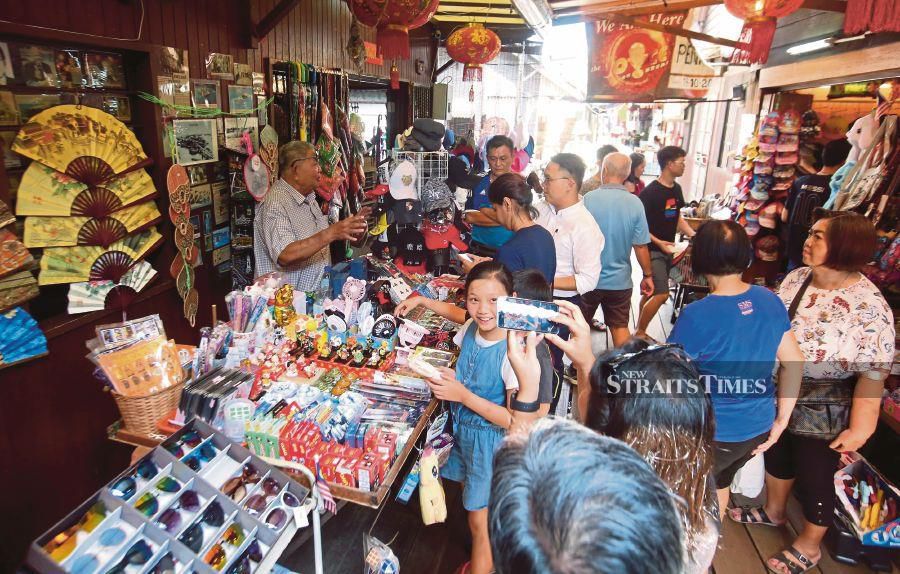
Tourists buying souvenirs at Chew Jetty, Pengkalan Weld. - NSTP/Danial Saad
George Town World Heritage Inc (GTWHI), which manages the World Heritage Site here, said clan jetties need to decide what they want in terms of allowing tourists to flock to their homes.
GTWHI general manager Dr Ang Ming Chee says the clan jetty chiefs acted on consensus when they decided to allow residents to set up trinket shops and other businesses to capitalise on the high tourist flow.
She says GTWHI respects their wishes, but if some quarters are not to keen to have too many tourists, they ought to bring it up to their respective clan chiefs.
“GTWHI can’t take over the jetties as it is under the control of the respective clan chiefs.
If they want to limit tourists entering the area, then they have to bring it up to their chiefs.”
Ang says public feedback is welcome as the state government is reviewing its George Town Special Area Plan.
However, as site managers, she says they are obliged to protect the clan jetties, ensure sustainable tourism and ensure the residents’ future generations continue to live there.
“We want their offspring to continue staying there in preserving the intangible culture that is synonymous with George Town.
“So we will do all we can to ensure that the clan jetties continue to be a safe and comfortable place for them to live in.”
Today marks George Town’s 11th anniversary as a World Heritage Site.
Ang adds that the state government has to ensure clean water supply to the homes in the jetties and carry out works to improve the sewerage system.
Pengkalan Kota assemblyman Daniel Gooi says the state government understands that residents need to make a living.
“It is not cheap to maintain their homes, so we understand that they need to make an income to help them sustain their living.
“Their shops are not legal as per the zoning of the jetties, which are essentially residential, but we are looking at changing the zoning to set better rules and regulations on operating businesses, including on the types of businesses allowed.”
Gooi says the state will help residents maintain the jetties’ boardwalk, improve the infrastructure and help maintain the houses of those who cannot afford to.
~News courtesy of New Straits Times~
Tourists buying souvenirs at Chew Jetty, Pengkalan Weld. - NSTP/Danial Saad
George Town World Heritage Inc (GTWHI), which manages the World Heritage Site here, said clan jetties need to decide what they want in terms of allowing tourists to flock to their homes.
GTWHI general manager Dr Ang Ming Chee says the clan jetty chiefs acted on consensus when they decided to allow residents to set up trinket shops and other businesses to capitalise on the high tourist flow.
She says GTWHI respects their wishes, but if some quarters are not to keen to have too many tourists, they ought to bring it up to their respective clan chiefs.
“GTWHI can’t take over the jetties as it is under the control of the respective clan chiefs.
If they want to limit tourists entering the area, then they have to bring it up to their chiefs.”
Ang says public feedback is welcome as the state government is reviewing its George Town Special Area Plan.
However, as site managers, she says they are obliged to protect the clan jetties, ensure sustainable tourism and ensure the residents’ future generations continue to live there.
“We want their offspring to continue staying there in preserving the intangible culture that is synonymous with George Town.
“So we will do all we can to ensure that the clan jetties continue to be a safe and comfortable place for them to live in.”
Today marks George Town’s 11th anniversary as a World Heritage Site.
Ang adds that the state government has to ensure clean water supply to the homes in the jetties and carry out works to improve the sewerage system.
Pengkalan Kota assemblyman Daniel Gooi says the state government understands that residents need to make a living.
“It is not cheap to maintain their homes, so we understand that they need to make an income to help them sustain their living.
“Their shops are not legal as per the zoning of the jetties, which are essentially residential, but we are looking at changing the zoning to set better rules and regulations on operating businesses, including on the types of businesses allowed.”
Gooi says the state will help residents maintain the jetties’ boardwalk, improve the infrastructure and help maintain the houses of those who cannot afford to.
~News courtesy of New Straits Times~
Thursday, 4 July 2019
Upcoming flights between Melaka, Penang cancelled until Saturday (July 6)
Upcoming flights between Melaka, Penang cancelled until Saturday (July 6)
All flights between Melaka and Penang have been cancelled until Saturday (July 6) following a navigation system failure at Melaka International Airport (LTAM) in Batu Berendam.
AirAsia confirmed in a statement that six of its flights will be cancelled as the VHF omnidirectional range (VOR) navigational aid and Instrument Landing System (ILS) at the Melaka International Airport in Batu Berendam were inoperable.
An AirAsia spokesperson said the flights to-and-from Melaka will resume on July 6 when its systems are back online.
"We have contacted all affected guests and offered them alternatives.
"Guests may either move their travel dates, retain their fare values in their credit accounts for future travels or opt for a full refund," she said.
Guests who were affected by the cancelled flights may contact the AirAsia support team at https://support.airasia.com/s/?language=en_GB
It was earlier reported that flights AK6284 (Penang to Melaka) and AK6285 (Melaka to Penang) Wednesday (July 3) were cancelled following an apparent failure in the navigation system at LTAM.
It was learnt that AirAsia had sent buses to transport the stranded passengers in Melaka to KLIA2 to put them onboard Penang-bound flights.
~The Star~
All flights between Melaka and Penang have been cancelled until Saturday (July 6) following a navigation system failure at Melaka International Airport (LTAM) in Batu Berendam.
AirAsia confirmed in a statement that six of its flights will be cancelled as the VHF omnidirectional range (VOR) navigational aid and Instrument Landing System (ILS) at the Melaka International Airport in Batu Berendam were inoperable.
An AirAsia spokesperson said the flights to-and-from Melaka will resume on July 6 when its systems are back online.
"We have contacted all affected guests and offered them alternatives.
"Guests may either move their travel dates, retain their fare values in their credit accounts for future travels or opt for a full refund," she said.
Guests who were affected by the cancelled flights may contact the AirAsia support team at https://support.airasia.com/s/?language=en_GB
It was earlier reported that flights AK6284 (Penang to Melaka) and AK6285 (Melaka to Penang) Wednesday (July 3) were cancelled following an apparent failure in the navigation system at LTAM.
It was learnt that AirAsia had sent buses to transport the stranded passengers in Melaka to KLIA2 to put them onboard Penang-bound flights.
~The Star~
Subscribe to:
Posts (Atom)